Living is no laughing matter: you must take it seriously, so much so and to such a degree that, for example, your hands tied behind your back, your back to the wall, you can die for people, even for people whose faces you’ve never seen, even though you know living is the most real, the most beautiful thing.
You must grieve for this right now, you have to feel this sorrow now, for the world must
be loved this much if you’re going to say “I lived”…
— Nazim Hikmet, On Living

Nazim Hikmet wrote those lines in a Turkish prison, doing time for the crime of being a communist. He would spend seventeen years inside before escaping into exile. Yet from his cell he was writing about Vietnam, about Africa, about the colonized world, about people whose faces he would never see. To grieve for strangers, to feel their struggle as your own. Hikmet understood this as the precondition of any serious political life.
In January 1966, five hundred and twelve delegates from eighty-two nations arrived at the Hotel Habana Libre in Havana. They came from Africa, Asia, and Latin America. They came from countries still fighting liberation wars, from newly independent states waking up to the fact that flag independence was not the same as freedom, from underground movements, from guerrilla fronts, from trade unions and student organizations and peasant federations. Alongside them came two hundred and seventy observers journalists, poets, novelists. For fifteen days they met, argued, and built something together. They called it the Tricontinental Conference, and out of it they founded OSPAAAL: the Organization of Solidarity of the Peoples of Asia, Africa and Latin America.
We should know this history. Most of us don’t. That is not an accident. Imperialism has erased sources that challenge it.
Before Havana, there were assassinations. Patrice Lumumba had been the first Prime Minister of an independent Congo. He was in office for less than three months before he was kidnapped, tortured, and shot with the direct involvement of the CIA and Belgian intelligence. He was thirty-five years old. His crime was wanting his country’s resources to belong to his country’s people.
Frantz Fanon the Martiniquais psychiatrist who joined the Algerian revolution and wrote The Wretched of the Earth, the book that a generation of Third World revolutionaries carried like a weapon spent his final years theorizing liberation from Tunis alongside his wife Josie, surviving multiple attempts on his life, before dying of leukemia in 1961 at the age of thirty-six.
Mehdi Ben Barka was the Moroccan revolutionary appointed as secretary to the Tricontinental conference. He never made it to Havana. Two months before the conference opened, he was abducted outside a Paris brasserie and murdered almost certainly by a combination of Moroccan intelligence, French police, and the CIA. The conference convened with his absence at its center.
Che Guevara, who had helped make the Cuban revolution, would be captured and killed in Bolivia in 1967 once again, CIA assistance confirmed. He was thirty-nine.
Imperialism, then as now, does not argue with its opponents. It kills them. And it was in the shadow of these killings with these absent comrades present in every resolution and declaration that the Tricontinental met.
Cuba in 1966 was the right place for such a meeting. Mehdi Ben Barka had noted, in a preparatory gathering a year before, that the Tricontinental would bring together for the first time the two great currents of world revolution: the socialist tradition born in 1917, and the anti-imperialist national liberation movements of the present moment. Cuba was the product of both. It had made a revolution ninety miles from the United States, and was still standing.
The Cuban people threw themselves into the conference. Sixty thousand study circles were organized across the country by the Committees for the Defense of the Revolution, holding seminars and lectures on the liberation struggles of Asia, Africa, and Latin America. Over two million Cubans took part. Murals went up. Flags of the participating nations hung from buildings across Havana. For ordinary Cubans, the conference was an education in the idea that their revolution belonged to the world that liberation anywhere was connected to liberation everywhere.
States pursue interests. Cuba was doing something else: practicing internationalism as a way of life. Cuban fighters would later go to Angola. Cuban doctors would go to dozens of countries. When Mandela was released from prison in 1991 after twenty-seven years, one of the first things he did was go to Cuba to thank Fidel Castro in person. Who had trained their people, Mandela asked? Who had given resources, helped their soldiers, sent doctors? Cuba had a small Caribbean Island with no particular strategic gain to be made, acting out of obligation rather than calculation.
At the conference itself, two presences deserve special attention.
The Vietnamese delegation sat in that room while their country was being bombed by the most powerful military force in human history. The United States had been escalating its war in Vietnam since 1964. By 1966 there were nearly four hundred thousand American troops on Vietnamese soil. The Vietnamese came to Havana to report on a war they intended to win and to insist that the anti-imperialist struggle was indivisible. Vietnam was the test case. Could imperialism be defeated in the field? The whole Third World was watching.
Amílcar Cabral was there too, leading the delegation of the PAIGC the movement fighting for the liberation of Guinea-Bissau and Cape Verde from Portuguese colonialism. Cabral was one of the most extraordinary political thinkers of the twentieth century, and his presence at Havana was electrifying. His argument cut to the bone: national liberation is above all an act of culture. Colonialism steals land and resources, yes, but it also steals a people’s sense of their own history, their own agency, their own humanity. Resistance therefore means remembering, theorizing, creating the gun and the poem answering the same necessity. Culture is where the most fundamental battles are fought.
This argument resonates close to home. We come from a tradition the Progressive Writers’ Association, Faiz, Manto, Sahir — that understood this instinctively. The pen and the fist were never separate. The Tricontinental was, among other things, the moment when that understanding was given global institutional form.
Faiz Ahmad Faiz himself met Nazim Hikmet. He met Pablo Neruda. These encounters were the human fabric of a planetary network of resistance poets who understood that imperialism has a culture and that it must be fought with culture, as well as with everything else. Faiz visited Cuba in 1972 and wrote a travelogue of what he saw. He carried the Tricontinental spirit in his bones without ever needing to name it.
The connections multiply when you look. Che Guevara traveling through Algeria to Dar es Salaam and on to the Congo. Malcolm X passing through Dar es Salaam a year earlier, meeting exiled anticolonial leaders in the café of the New Africa Hotel. Walter Rodney in Tanzania studying African history and building the intellectual foundations for How Europe Underdeveloped Africa the book that would explain, with devastating clarity, that African poverty was a product of deliberate extraction. CLR James and Aimé Césaire celebrating James’s sixty-seventh birthday together in Havana in 1968 at the Cultural Congress, surrounded by intellectuals from seventy countries debating the responsibilities of the writer in a time of struggle.
All of it was the product of a conscious, organized effort to build a planetary consciousness the understanding that the division of humanity into oppressors and oppressed cuts across all national borders, and that the task of the left everywhere is to act on that understanding.
OSPAAAL produced a magazine called Tricontinental and a bulletin published monthly in English, Spanish, French, and Arabic. Copies reached Lahore. They reached Dakar and Dhaka and Dublin. The solidarity posters that OSPAAAL produced graphic works of astonishing power, with a visual language that owed something to socialist aesthetics but was distinctly Third World in its reference and its fury were inserted into the magazine and mailed around the world. They were pinned to walls in student hostels and union offices from Karachi to Berlin. Some of them are still in use by movements today.
Internationalism, in practice, is labor. Translation, printing, mailing, organizing study circles building the material infrastructure through which people who will never meet each other can nonetheless think together and act together.
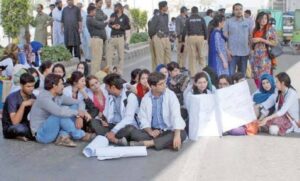
We are the inheritors of this tradition whether we know it or not. The Progressive Writers’ Association was part of the same current. Faiz was part of the same current. The students who protested the American war in Vietnam from the streets of Lahore in the 1960s were part of the same current. The question is whether we are willing to claim the inheritance.
Imperialism has not ended. The bombs that fall on Gaza are made in the same country that funded the murder of Lumumba. The debt structures that strangle the Global South were designed by the same institutions that worked to undermine every Third World government that tried to control its own resources. The world that the Tricontinental was fighting against is still here. It is just better dressed.
The Tricontinental gives us a method: the insistence that our local struggle is part of a global one, that we are responsible for what happens to people whose faces we have never seen, that the work of liberation is simultaneously political and cultural and intellectual, that solidarity has to be practiced, built, maintained. It gives us the memory that it has been done before that five hundred delegates from eighty-two nations once sat together in a room in Havana and decided that the world must be loved enough to be changed.
Hikmet wrote from his prison cell about dying for strangers. The people who came to Havana in January 1966 had already done that, many of them.
The world must be loved and a planetary consciousness must be made actional.